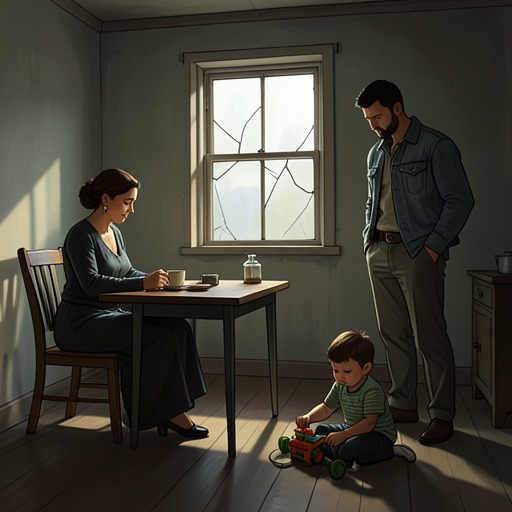
Homelessness and housing insecurity
Hayden's TimbreHomelessness and housing insecurity are presented as a cascading social and emotional condition rather than a single loss of shelter. For Timbre Simons, the collapse begins with unemployment, the departure of her roommate Caylor, the sale of her car, and the exhaustion of her remaining savings. The shelter offers immediate safety, but it also places every part of daily life—transportation, money, privacy, work, and personal disclosure—under pressure. Her later movement toward employment and a room of her own shows recovery as a collective process, even while her fear of stigma makes accepting assistance difficult.
Definition and Material Conditions
Timbre’s housing insecurity follows the rapid disintegration of a previously recognizable independent life. Four months after the earlier events, she sits on a twin bed in a shelter and measures what has disappeared: a job, an apartment shared with Caylor, a car, and the expectation that ordinary life could continue. She has sold the car to pay the last of the month’s bills, expects her cell service to last only one more month, and knows that minimum-wage work will not be enough to restore stability. Student-loan debt continues to accumulate, making the crisis more than a temporary shortage of cash.
The loss of housing is linked directly to the loss of employment and household partnership. Caylor’s sudden move to Los Angeles leaves Timbre without the roommate who had helped cover rent, while the job she finds after one bad day is difficult to replace. Her description of the downward spiral emphasizes speed: an apartment, transportation, income, and privacy vanish in succession. The shelter is therefore both refuge and evidence of how quickly a precarious arrangement can fail.
Shelter, Work, and Daily Survival
The shelter provides a practical platform from which Timbre can attempt to rebuild. Jenna gives her the name and address of a bar, and the bus route running directly in front of it makes applying possible after Timbre has sold her car. She chooses her last pair of good jeans, finds a shirt that needs ironing, and relies on the shelter’s facilities to prepare for the interview. Housing support thus becomes connected to employment support: the shelter helps women get back on their feet, while its location supplies access to a job market that would otherwise be difficult to reach.
Her first shift at The Bar reveals the limits of that opportunity. The room is unexpectedly quiet on a Tuesday, and Timbre cannot understand why Ford has brought her in when Jenna could handle the few customers alone. The work is not simply a wage-paying solution; it exposes her to customers’ wandering eyes and hands, with the expectation that she must identify harassment and rely on Ford to intervene. The bar’s anti-harassment structure offers some protection, but the danger remains part of the labor she performs. Her housing insecurity therefore intersects with gendered vulnerability: the job that may rescue her financially also places her body in a space where boundaries must be defended.
The income arrives immediately enough to create hope. After returning to the shelter, Timbre describes having a job, making instant money, and possessing a clean place to sleep as the possible beginning of a new life. Yet the optimism is deliberately fragile. She keeps repeating that things can only improve, without fully believing it, and carries her purse into the shower because the occupied beds make leaving her money unattended feel unsafe. Even rest is organized around work: she regularly returns between three and four in the morning, sleeps until late morning or noon, and finds that standing through bar shifts leaves her too exhausted to wake easily.
Her budget remains severe. Saving for her own place becomes the central reason for working, but suitable work shoes come before nearly everything else because her feet hurt on shift. The shelter supplies some food, and Ford commonly pays for a meal, recognizing that Timbre and Jenna may need one substantial meal each day. These details show survival as a network of small arrangements rather than a single act of self-sufficiency. Transportation, food, footwear, safety, and paid labor must all be coordinated before independent housing becomes possible.
Stigma, Secrecy, and Exposure
Timbre’s insecurity is intensified by shame and the anticipation of judgment. She lies to Caylor almost every day about where she sleeps because she believes he would return to Austin immediately if he knew, potentially interrupting the modeling contract he has finally obtained in Los Angeles. Her secrecy is not indifference to him; it is an attempt to protect his opportunity and preserve her own image of competence. The shelter becomes a fact she must manage socially as well as materially.
She also encounters the withdrawal of people who had seemed like friends once they learn where she lives. Their disappearance confirms that housing status changes how others evaluate her, while also clarifying which relationships are genuine. Against those losses, Jenna’s friendship becomes significant because it is formed through practical solidarity: a recommendation, shared days off, a ride to work, and the chance to eat a real meal together. The shelter is not portrayed only as a site of deprivation; it is also where a new support network begins.
When Hayden Devillier discovers that Timbre lives in a shelter, his reaction exposes the class difference between them. He has been trying to understand why her current residence does not resemble the apartment he expected, while Timbre hesitates before naming the building as a shelter for homeless people. She immediately insists that it is safe, pointing to the guard who controls entry, because she must defend the place against the assumption that it is simply dangerous or degrading. Her explanation makes safety a concrete institutional arrangement rather than a sentimental reassurance.
The same disclosure becomes a test of trust in Hayden’s family circle. Hayden tells Peri Powell that Timbre is trying to save for an apartment, and Peri worries that Timbre may know Hayden has money and be seeking an easy escape. Hayden rejects that interpretation, explaining that Timbre refused the money he offered and that her pride has been damaged by the setback rather than erased. Her refusal distinguishes assistance from dependence: she needs housing, but she does not want housing to become a debt or proof that she has entered a relationship for financial rescue.
Housing as a Social and Relational Issue
Timbre’s work schedule makes intimacy difficult because the shifts that produce the most money fall on Friday and Saturday nights. Hayden explains that weekend dates are therefore impossible, while weekday plans collide with his responsibilities to Crew Devillier and Timbre’s own schedule. Housing insecurity affects romance through time as well as money: the labor required to escape the shelter leaves little room for courtship, and Hayden’s parental obligations further narrow the available hours.
The response from Hayden’s wider circle begins to redefine help as shared care. Peri tells Timbre that moving into the Powell family pool house would give her a suitable place to live, even though the offer is framed as something that would also benefit the household. Timbre agrees because she needs almost no space after having no room at all, but her embarrassment remains visible when she learns Hayden has told Peri where she lives. The offer does not erase the humiliation of displacement; it creates a safer material condition in which she can continue working and build toward stability.
The pool house also places Timbre inside a family system rather than merely supplying a private room. She discovers Hayden, Crew, and Tucker Powell at her table with homework spread across it and food cooking on her stove. The scene turns housing into participation: the room is no longer only a place where she sleeps, but a domestic space shared with people whose routines and responsibilities now overlap with hers. Peri’s warning that Hayden is like the little brother she never had, and that Assured Distraction functions as his family in Austin, makes clear that accepting the room also means entering a network of loyalty and protection.
Threat, Displacement, and Significance
The contrast between shelter as protected refuge and home as vulnerable possession becomes stark when Krissy Thompson confronts Timbre. Timbre is drugged and wakes to Krissy’s demand that she leave, followed by threats that she will be killed for taking what Krissy considers hers. The language used against her reduces her housing history to an insult, turning homelessness into a weapon of humiliation. Krissy’s attack demonstrates that private housing within a chosen family does not automatically end insecurity; Timbre’s place can still be challenged by someone who seeks to reclaim Hayden Devillier, Crew, and the social world around them.
Earlier, the night bus ride from the shelter shows that even the route between work and bed is precarious. Timbre chooses a seat near the driver for safety, but older teenage boys sit behind her, laugh while looking at her, make a sexual taunt, and crowd her against the wall when one sits beside her. The driver appears not to intervene. Her shelter may have a guarded entrance, yet reaching it requires navigating public space where gender and isolation expose her to harassment.
The novel ultimately treats housing insecurity as a condition that reorganizes identity and relationships. Timbre is not defined by helplessness: she works exhausting shifts, saves what she can, protects Caylor’s opportunity, refuses Hayden’s money, and makes decisions about her own safety. At the same time, the narrative refuses to present independence as sufficient protection. Jenna’s practical friendship, Ford’s meals and workplace enforcement, Hayden’s concern, and the Powell family pool house all make reconstruction possible. The larger family history reinforces this value: Hayden’s response to Crew Devillier’s birth involved moving into the hospital room, feeding him, changing him, and bringing him into a home shared with Peri Powell and Ryan Powell. Across both stories, shelter is sustained not only by individual effort but by people who assume responsibility for one another. Homelessness and housing insecurity therefore become a measure of who is willing to protect dignity when money, privacy, and conventional family structures fail.